
If you manage Pay-Per-Click (PPC) Advertising campaigns, then you’re asked to report on campaign results, share insights, and translate data for your clients and stakeholders. This can be a daunting task. Regardless if your results are positive, will your audience understand the data that you share?
Data storytelling is the art of transforming raw data into compelling narratives that drive action. In the realm of Pay-Per-Click Advertising, this skill is essential for making informed decisions, optimizing campaigns, and ultimately achieving business goals.
For example, if a Google Ads Search campaign’s Click-Thru Rate (CTR) improved over the last quarter, this a positive metric to share with your client. You could simply send an email stating, “In Q3, our campaign CTR improved to 7.89%, up from 5.24% in Q2.” However, this could be ineffective in showing the value of the campaign and your campaign management.
- Does the client understand what CTR means? Even if it has been discussed or explained previously, will the client recall the definition in this context?
- Does the client understand this is a significant change? The email communicates an increase from the previous quarter, but the client could understand the change to be minor or unlikely to impact business goals.
- Will the client recall the information in the future? People have a 5-10% retention rate when they hear a statistic (source). This data point will likely be forgotten very soon after the client closes the email.
To better communicate the data to the client, you could instead include a visualization, such as a bar chart or line graph. This could make the information more digestible. For example, you could send the client the below graphic and accompanying text.

In Q3, our campaign Click-Thru Rate (CTR) improved to 7.89%, up from 5.24% in Q2.
Click-Thru Rate measures the percentage of people who click on an ad relative to the total number of people who viewed it. It’s calculated by dividing the number of clicks by the number of impressions.
- The bar chart visually communicates the increase to the client, showing the increase as more significant than with just metrics. Further, People have a 25% retention rate when a statistic has an image (source), making this more memorable than the simple email, but it could still be better.
- The image caption includes a definition for CTR, ensuring the client has a general understanding of the reported metric. However, context is still missing. There could be greater details around what led to the improved CTR, how to continue growing CTR over Q4, or how CTR impacts other key performance metrics.
To best communicate the data to the client, you need to tell a story. People have a 60% retention rate when a statistic has a story (source). Stories will be the easiest for clients to understand and the easiest way to show your value. See the graphic below and accompanying text for an example of effective data storytelling.
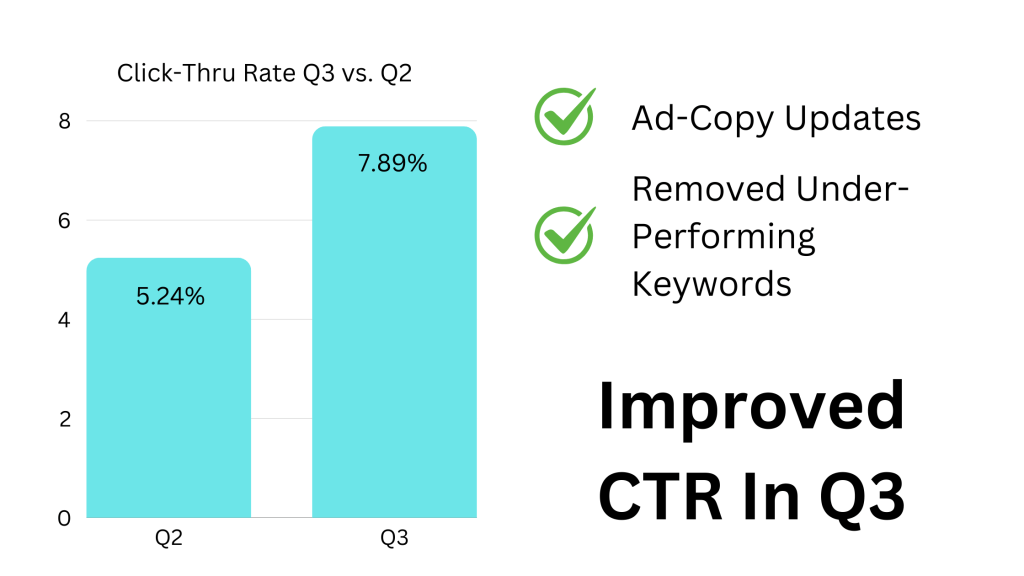
In Q3, our campaign Click-Thru Rate (CTR) improved to 7.89%, up from 5.24% in Q2, due to updating the campaign ad copy and removing the under-performing keywords. Improving our CTR, means that our campaign is targeting users who are more likely to click on our ads. This improvement can help us better reach our ideal customers and maximize our advertising budget.
Click-Thru Rate measures the percentage of people who click on an ad relative to the total number of people who viewed it. It’s calculated by dividing the number of clicks by the number of impressions.
If you sent this story to the client, they would have a great understanding of CTR, why its improvement was significant, how the improvement was achieved, and how this will impact other key business goals.
In Summary: Data-storytelling is how Pay-Per-Click Advertisers can go beyond sharing campaign results. By identifying trends, highlighting optimizations and communicating why, you can build relationships and show your worth for your clients and stakeholders.

 Andy Hendricks
Leave a reply to 5 Strategies for Reporting on Under-performing Paid Media Campaigns – Andy Hendricks Cancel reply